
„Pole Pole” 8a 350m – South face of Mount Poi
Pole Pole (8a, 350m) is a route established in August 2026 on the South Face of Mount Poi in Ndoto mountains in northern Kenia by Paweł Bańczyk, Krzysztof Pałka, Łukasz Muller. The route was led, bolted, and cleaned entirely ground-up over six days, utilizing fixed ropes on the first five pitches. The first free ascent took place on August 27th in a 12-hour push. With the exception of the crux second pitch, which required 4.5 hours of work and dozens of attempts, every pitch was freed on the first go that day.
Although the route goes at 8a, the crux boulder can be easily aided, bringing the grade down to 7b+ A0. The line is fully equipped with 9cm, 10mm Lappas 316L stainless steel expansion bolts and ring hangers at belay stations. A single rope is entirely sufficient for the ascent. Following the cleaning process, there are no major loose rocks. Apart from pitches 3 and 4, the rock quality is exceptional.
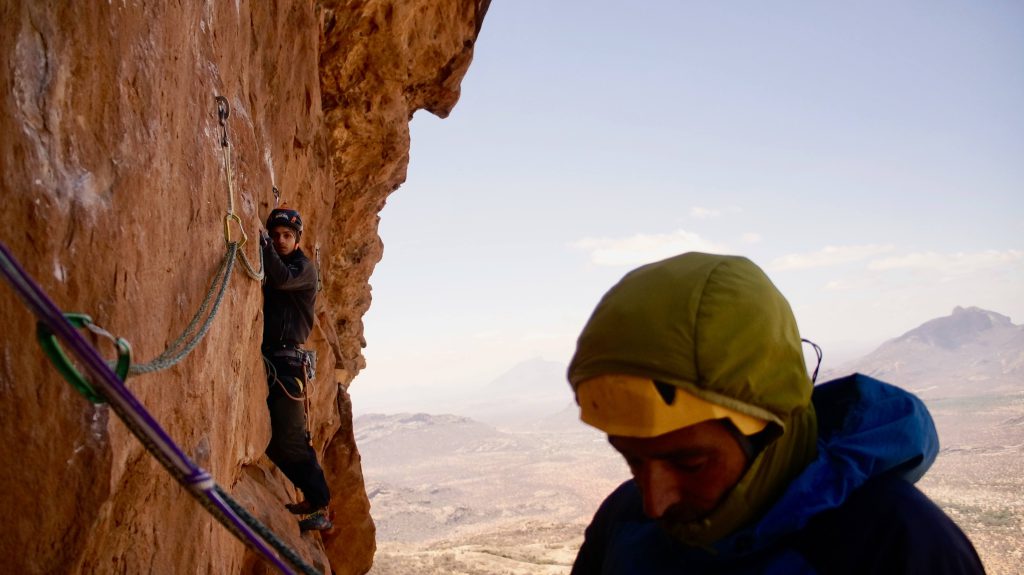
The south face of Mount Poi is shaded only during the dry season from June to October. During the secondary dry season, it is exposed to full sun all day. Despite high temperatures down in the village, the combination of shade and wind on the wall provided excellent climbing conditions.
Rappelling the route is highly problematic, due to a long traverse on a second pitch (an additional rappel station was made on the left side of the ledge) and the roof on the fifth pitch due to a massive horizontal roof.
The approach takes 3 to 3.5 hours from the trail start, with local guides or porters available for hire. A comfortable bivy site for several people is located directly at the base of the wall. There is absolutely no water near the base; the entire supply must be brought up.
Caution is advised regarding local wildlife. Expect elephant tracks on the approach, vultures on the wall, and scorpions or snakes at the base. All food supplies must be strictly secured against mice and monkeys at the bivy.
Approach
From Ngurunit village, take a motorcycle or car to the end of the road at the base of the mountain. There are several approach options.
Path [1]: The most direct and shortest line, however very thorny
Path [2] (Recommended): Easier and less thorny, following established animal trails. A recorded track is available here: https://strava.app.link/8JLpeaD0e6b.
Path [4]: Follows the standard hiking route toward the summit of Mount Poi, then traverses right onto a distinct shepherd’s path.
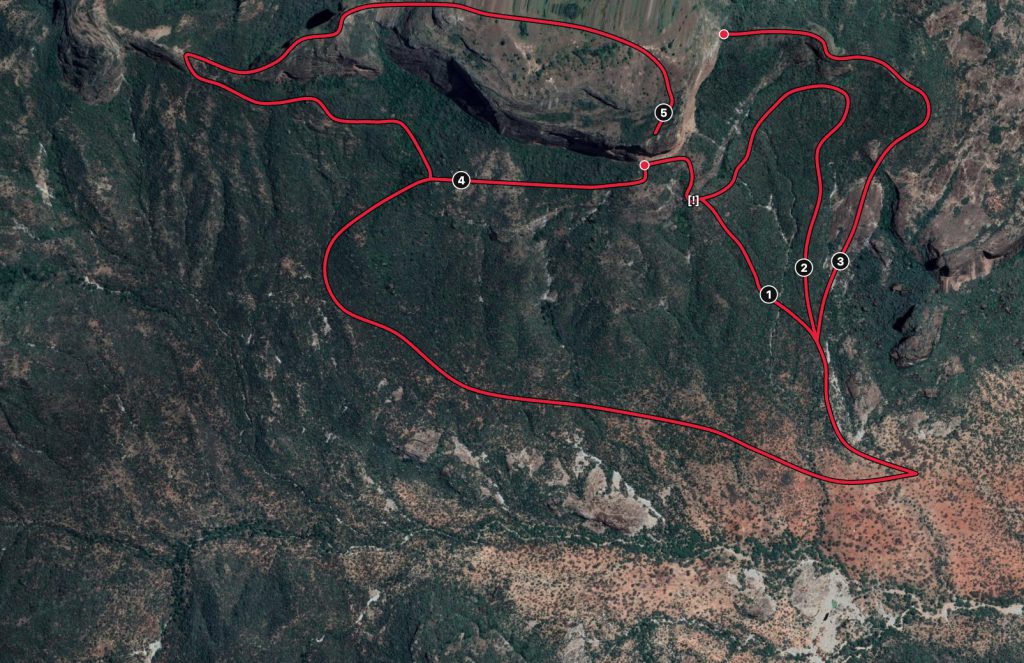
At the spot marked [!], scramble up a slabby boulder trending left. Next, turn right and pass under small rock overhangs through a narrow gap in the bushes. This serves as a natural gate used by local shepherds to enclose their pastures (see photos below).


Climbing
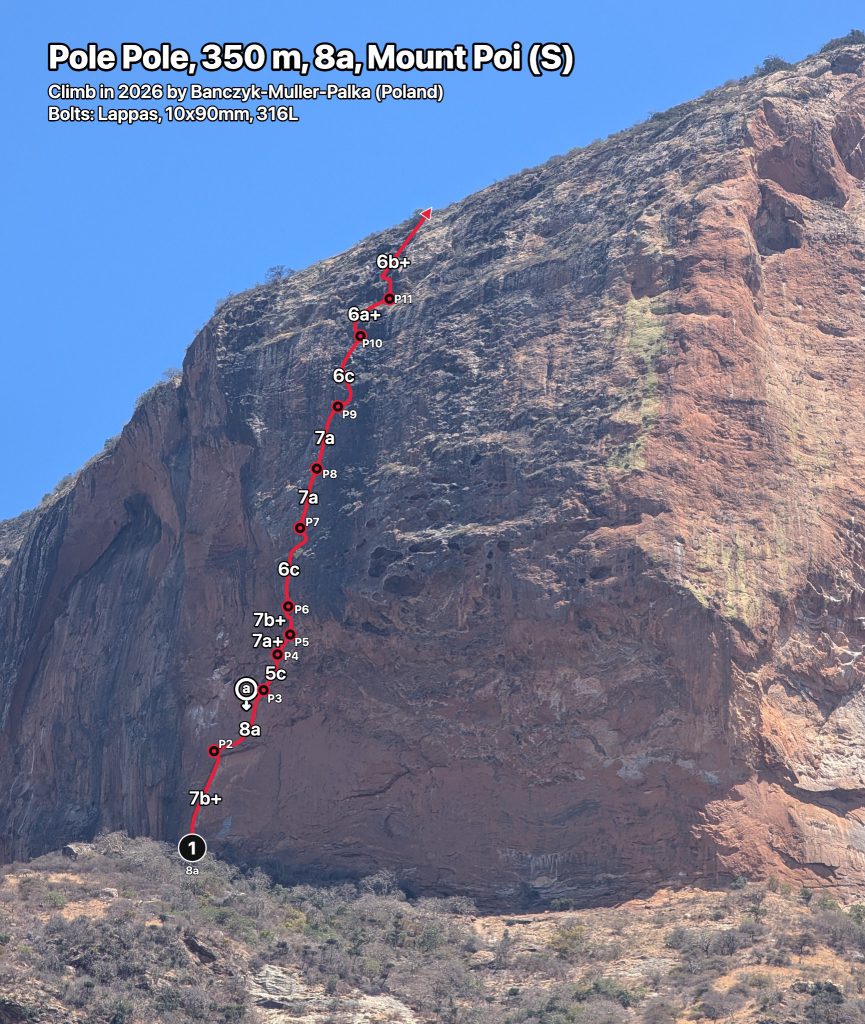
- Trad corner, 7b+, 45m, 2 bolts, 4 pitons
A beautiful right-facing corner, protected mainly with Camalots. There is one piton in the bottom section, and three pitons and two bolts on the top boulder. For a bold climber moving efficiently through the lower part, a single set of Camalots from 0.3 to 3 might be enough. An additional set of Camalots from 0.3 to 2 is recommended. - Crux traverse, 8a (or 7b+ A0), 30m, 11 bolts, 1 piton
A long traverse with a brutally hard, technical boulder problem right off the belay. The boulder problem starts with good holds just to the right of the belayer’s feet. It is likely to feel significantly easier for taller climber, making the grade very hard to pin down. It is very easy to skip the crux boulder by clipping and unclipping between the bolts. After the crux, the route eases into beautiful, sustained climbing at around 7b. Camalots 0.2 and 0.3 can be useful for the upper traverse section. - Honeycomb, 5c !!!, 20m, 7 bolts
An incredible pitch on some of the loosest rock imaginable. Micro-choss taken to an absolutely ridiculous level. - Choss crux, 7a+ !!!, 15m, 5 bolts
Similar rock quality to the 3rd pitch, but features a hard overhang that can have a completely different hold layout after every attempt. - Roof, 7b+, 15m, 6 bolts
A horizontal roof followed by a tricky move onto the slab. A real pain to follow with a backpack. This is the pitch that makes rappelling the route almost impossible. From here on, the rock quality finally becomes excellent. - Pillar, 6c, 35m, 9 bolts
A nice climb on excellent rock. At the end of the pitch, traverse right along the ledges, then head left to the belay. Long slings are useful. - Small Siurana, 7a, 30m, 12 bolts
A beautiful pitch, straight out of Siurana, with flawless rock quality. - Boulder to boulder, 7a, 35m, 10 bolts
Successive bouldery sections with no hand rests in between. - Technical slab, 6c, 45m, 12 bolts
Traverse right to a large grassy ledge. Climb up and head left onto a beautiful slab. Then climb a system of ledges to the belay located in a small round hole. Expect runouts. - To the bush, 6a+, 20m, 6 bolts
Traverse right on beautiful slab climbing, then stay to the right of the trees. The move into the bushes can be tricky. Belay at the black rock. - To the top, 6b+, 50m, 9 bolts
Head into the roofs on the left, then climb through the chimney and up the slab to the tree on the edge of the wall. Expect long runouts. Long slings and 0.2–0.4 Camalots may come in handy.
Summiting
After reaching the anchor under the tree, scramble up to the tree and go right onto slabby ledges. Find a way through the bushes and head slightly right towards the east face. At the end of the bushes, find a way through another rock wall. We managed to pass it using a grade III scramble. Then reach the summit via the grassy slopes.
Descend
From the top head west. Use a normal path to the mountain, marked as [5] on the map. There is a possibility to go back to the start of the route. Track: https://strava.app.link/0jBg2lG0e6b.


